

Whose Epic Fury?
President Trump says the war could last a month after US-Israeli strikes kill Iran's supreme leader Ali Khamenei. There's little chance the US will achieve its strategic goals but others stand to win.

US military operations have overblown code names. ‘Midnight Hammer’ was invoked to strike Iran’s nuclear sites last June and ‘Absolute Resolve’ for the raid to capture Nicolas Maduro. This time Israel opted for ‘Operation Lion’s Roar’ and the US, not wanting to lose the nomenclature arms race, settled on ‘Epic Fury’.
What’s in a name? This is Trump’s and Israeli Prime Minister Netanyahu’s coup de grâce against their hated foe, the Islamic Republic of Iran. But whose fury is truly being invoked here?
Trump’s motivation for launching this war seems less driven by American fury than by a typically idiosyncratic mixture of things. Frustration at not having brokered an end to Russia’s invasion of Ukraine by the fourth anniversary of that war last week. Anxiety around his domestic approval falling to just 38%. And a clear timeline leading to the US midterm elections this November.
Khamenei’s death may boost Trump’s braggadocio even more than the US airstrike that killed Iran’s legendary Islamic Revolutionary Guard Corps (IRGC) leader Qasem Soleimani in January 2020. Both then and now, ordering operations that contributed to killing Iran’s senior-most leadership allows Trump to cast himself as the ultimate avenger in a US duel with Iran that has persisted since 1979.
Senator Lindsay Graham just reminded us he considers Iran “the mothership of international terrorism”, with memories dating back to the embassy hostages of 1979, Hezbollah’s bombing of the US marine barracks in Lebanon in 1983, and so on.
The real questions now are twofold: whether the US can achieve its objectives, and whether Trump is being played.
The US operation may be called ‘Epic Fury’ but it is not clear whose fury is being invoked. The fury of other parties are even more material to what is transpiring.
The US seeks unattainable goals in Iran
In a pattern often seen in history, Trump is emboldened by the apparent ease of one military operation (Venezuela) to double or triple his luck with bigger challenges. Bush from Afghanistan to Iraq or Putin from Syria to Ukraine, we’ve seen this hubris before.
Trump must now withstand domestic unease over the first US military deaths from Iranian strikes (the Pentagon says three were killed in an Iranian strike on Kuwait). Trump is also gambling on not contradicting his campaign promise to avoid ‘forever wars’.
He did not foreswear all kinds of wars, however. As recently as November 2025 he signed off this passage in the US ‘National Security Strategy’ (page 5):
We want to prevent an adversarial power from dominating the Middle East, its oil and gas supplies, and the chokepoints through which they pass while avoiding the “forever wars” that bogged us down in that region at great cost;
Airpower, airstrikes and standoff weapons are his guarantee to avoid American ‘boots on the ground’. The assumption is questionable and currently rests on whether Iran’s lashing out with missiles against the Gulf States and Israel can deplete these countries air defences or not. A truly devastating strike on a Gulf metropolis changes everything.
One authoritative voice on the prospects for military success is US political scientist Robert Pape, famed in the academia of strategic studies for Bombing to Win (1996), a critical examination of airpower as a tool to achieve coercive political ends in war. Professor Pape is well worth following on X. As he just wrote:
Decapitation worked.
Deterrence did not.
Escalation is accelerating.Precision gives leaders the illusion of control.
Reality removes it.
Events could yet head in many troubling directions.
The only outcomes so far guaranteed are the destruction of Iran’s military equipment and the deaths of its personnel and civilians. There is little assurance the joint US-Israel coercive bombing and assassination campaign will succeed in its political aim of collapsing Iran’s theocratic regime. Especially since there is no path to a stable political transition.
What about Reza Pahlavi’s supporters?
There is fury among swathes of Iran’s populace against the theocratic regime, both generational fury and fresh anger seeped in the blood of the slain protesters of recent months. But what promises have some Iranian exiles made to the US, to bolster its confidence that a simple path to regime change is coming? Or has Trump simply drawn naive impressions as to what comes next?
Exiled in the USA, Reza Pahlavi is the eldest son of the last shah of Iran, a Cold War-era US ally deposed in the Iranian revolution of 1979.
Reza Pahlavi is 65 years old and though there is no clear path for him to return to Tehran and avenge his father’s toppling, his global network of supporters have been out in force in recent months, in solidarity with protesters who were brutally suppressed by Iran’s security forces.
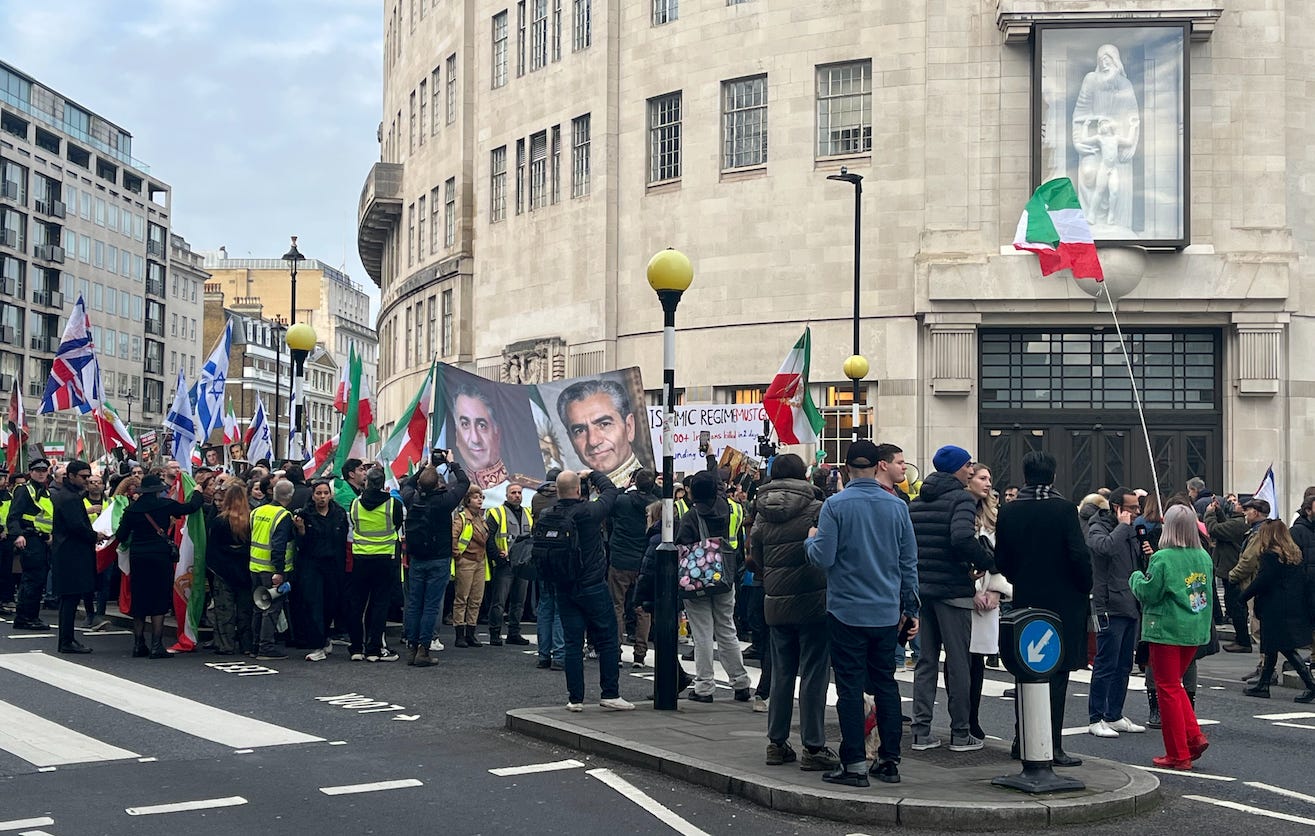
Here is an image from central London in January, for example, near the main BBC studio, as Reza Pahlavi’s supporters peacefully expressed their anger towards Khamenei’s regime and allegiance to the Pahlavi dynasty.
This weekend celebrations for Khamenei’s death took place in Los Angles and elsewhere. There are protests mourning his loss like this march to the US consulate in Karachi and an attempt by Khamaeni supporters to storm the US embassy in Baghdad.
Iran — a country of 93 million, 1.12% of the world's total population — is complex, diverse and in a fragile neighbourhood. There is little chance the country will unite behind Trump’s most critical message in his Mar-a-Lago speech announcing the start of the war:
Finally, to the great, proud people of Iran, I say tonight that the hour of your freedom is at hand…when we are finished, take over your government. It will be yours to take. This will be probably your only chance for generations.
There is no clear sense of a unifying figure, or a path to toppling the IRGC — only a path to causing massive devestation in Iran. This isn’t the only misleading factor in Trump’s calculations.
The Israel-isation of US military strategy
The US national security establishment is scarred by its post 9/11 defeats, not only Afghanistan and Iraq but the unsatisfactory outcome in Libya too. Just as the ghosts of Vietnam took a generation to banish, through a minor victory in Panama in 1989 and a major victory against Iraq in 1991, current US decision-makers are looking for a new winning streak. As Defence Secretary Pete Hegseth told US generals in September, “Lethality is our calling card and victory our only acceptable end state”.
Enter Benjamin Netanyahu, whose career began in earnest in the mid-1980s during his diplomatic posting to the USA as Israel’s UN Ambassador. In 1987 he published Terrorism: How the West Can Win, advocating a hardline, proactive counterterrorism strategy. He argued that international terrorism is not rooted in grievances but is a tactical tool of ‘totalitarian’ states, necessitating measures including military retaliation to destroy it.
Netanyahu (and the Israeli establishment writ large) has long wanted to influence the US government to decisively strike Iran.
It is now over 13 years since Netanyahu presented this notorious graphic of Iran’s proximity to developing a nuclear weapon, rendered akin to an Acme Loony Tunes cartoon bomb, to cajole the Obama administration and other states from signing a deal with Iran to limit its enrichment activities.
Then, Netanyahu’s efforts failed and the Iranian nuclear deal was inked in 2015. This time, he has his way first with ‘Midnight Hammer’ and now ‘Epic Fury’. Getting the US to attack Iran, now with the goal of regime change, is the greatest diplomatic triumph of Netanyahu’s career (as he will see it).
Israel’s military paved the way to US action with its ‘pre-emptive strike’ on Iran last June. The implication is clear: Israel leads on Iran and the Trump Administration follows.
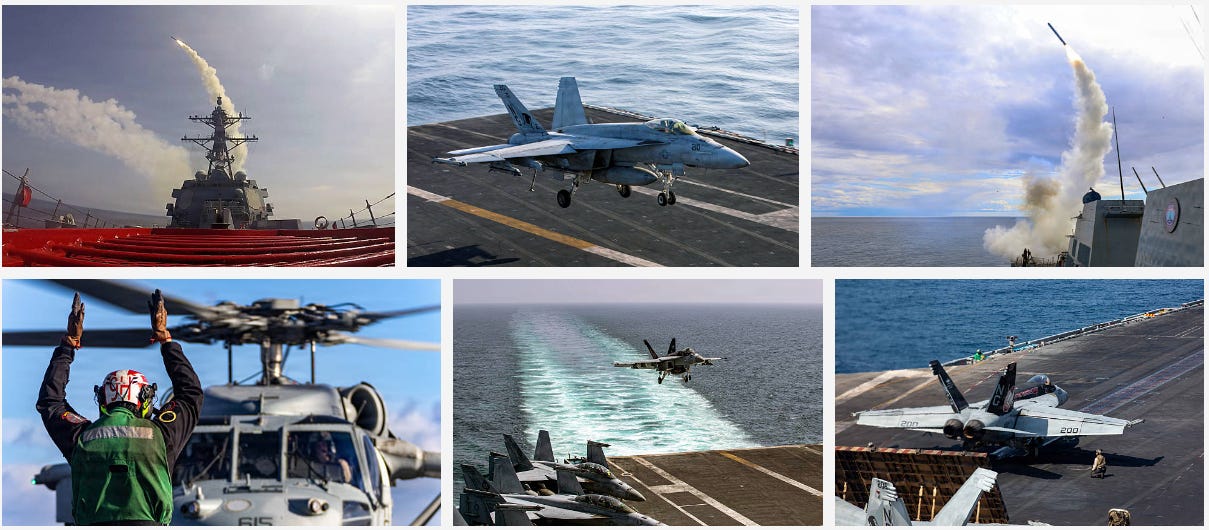
I would also surmise a creeping Israeli influence on wider US global military strategy. What Israel practises in relative microcosm is euphemistically referred to as ‘mowing the grass’: launching periodic strikes against its enemies like Hamas, Hezbollah and Iran to keep them in check, and to over-respond to any threat or provocation.
Trump’s evolving military strategy involves placing regimes like Venezuela and Iran under permanent watch, threatening deadly retaliation if they step out of line. If Hegseth is looking for winners his quest may have only led him as far as Israel.
Gulf fury
This is the part of US-Israeli strategy that has worked resoundingly so far: the Gulf Arab states have long held Iran in antipathy and are furious at Iran’s missiles strikes.
Iran sees these states as legitimate targets. Bahrain hosts the US fifth fleet HQ. Qatar hosts the Al Udeid Air Base. The UAE hosts Al Dhafra Air Base. In Iraq, the US maintains a presence at Ain Al Asad Air Base. Kuwait hosts US military installations, and US troops remain in Saudi Arabia.
Even Oman, host of the now defunct US diplomatic outreach to Iran, is in the firing line given Iranian attacks on shipping along the Straits of Hormuz.
The US-Israeli strategic calculation is for anger to rise to boiling point inside and around Iran to such levels that its hardline theocratic regime buckles. Even if it does, there are greater chances of civil unrest, civil war, and regional instability than a political transition to an Iranian regime that comes to heel.
At which point Netanyahu may feel as if he’s achieved Israel’s goals but Trump risks making the US look blundering, warmongering and bereft of real strategic outcomes.